Active ageing
Muscle carnosine and healthy ageing: what the research shows
Carnosine is one of the muscle's own acid buffers, and some studies report lower levels in older adults than in young adults. Here is what the evidence does and doesn't show, and what it means for staying strong and active over time.
Most of the longevity conversation right now is about the things you can measure on a watch: VO2 max, grip strength, resting heart rate, steps. Useful numbers, all of them. Underneath those numbers sits a quieter layer of muscle chemistry, and some of it changes with age.
Carnosine sits in that layer. It is a small dipeptide the body makes and stores in skeletal muscle, and research has studied it for decades as a pH buffer, an antioxidant and an anti-glycation agent. This article explains what carnosine actually does, what human research supports, where the evidence is still thin, and how any of it is relevant if you are forty, sixty or seventy-five and simply want to keep training and moving well.
What carnosine is, in plain terms
Carnosine is a dipeptide — two amino acids, beta-alanine and histidine, joined together. Your body synthesises it and stores most of it in skeletal muscle, with smaller amounts in the brain and other tissues. It is not a vitamin and not an essential nutrient; you make it, and you also get some from meat and fish.
The role it is best known for is intracellular pH buffering. When you work hard enough that energy production outruns oxygen supply, hydrogen ions accumulate inside the muscle fibre and the environment turns more acidic. That shift interferes with the contractile machinery. Buffers soak up some of those hydrogen ions and slow the swing, which is why muscle buffering capacity is closely tied to how long you can hold a hard pace.
In laboratory research, carnosine has shown activity across several pathways, including antioxidant, anti-glycation and metal-binding effects. That is why it attracts interest in ageing biology. Laboratory activity, though, is not the same as a proven effect in people.
How muscle carnosine changes with age
Two things happen in parallel as we age. Muscle mass and fast-twitch fibre area decline, and the chemistry inside the remaining fibres shifts. A small biopsy study compared nine sedentary adults aged 65–80 who had knee osteoarthritis with nine active adults aged 20–35, and found carnosine was about half as high in the older group's fast-twitch (type II) fibres. A larger scan-based study of 263 people aged 9–83 found muscle carnosine fell by about 16% from young adulthood to middle age, but was hardly lower in older adults than in middle-aged adults.
It is worth being precise here, because this is where a lot of online writing overreaches. These are observational measurements of tissue content. They show an association between older age and lower muscle carnosine. They do not, on their own, prove that the drop causes the loss of capacity you feel on a hill, and they do not prove that raising the number reverses it. Activity levels, fibre type, health conditions and diet may all play a part.
They do offer one possible piece of a familiar experience for many older athletes: the top end often goes first. Steady aerobic work often holds up remarkably well into the sixties and beyond. It is the repeated hard interval, the last flight of stairs with shopping, the sprint for the tram, that becomes noticeably harder to repeat.
What the evidence actually says
The strongest human evidence around carnosine and performance comes indirectly, through beta-alanine. Beta-alanine is the building block that limits how much carnosine muscle can make, and taking it by mouth raises muscle carnosine. That makes it the main way researchers test the buffering idea in people. It is not the same as carnosine applied to skin.
A systematic review and meta-analysis published in the British Journal of Sports Medicine pooled 40 placebo-controlled studies (1,461 participants) and found a small overall effect of beta-alanine on exercise measures (Saunders et al., 2017). Results depended on the type and length of exercise: in efforts of 30 seconds to 10 minutes, the effect was larger for exercise capacity (how long you can keep going) than for timed performance, where it was not significant. The honest summary is a small, exercise-specific effect.
Supported, with limits: oral beta-alanine, which raises muscle carnosine, had a small average effect on some high-intensity exercise measures in controlled trials.
Associated: some studies report lower muscle carnosine in older or middle-aged adults than in young adults. These are observations, not proof of cause.
Explored, not established: carnosine's antioxidant and anti-glycation activity as a contributor to healthy ageing — mostly mechanistic, animal and in-vitro work so far.
Not established: that any topical or oral carnosine product slows ageing, treats disease, or restores youthful muscle chemistry.
On the ageing side, most of the literature is mechanistic: laboratory work proposing ways carnosine might act on protein damage and glycation (Hipkiss et al., 2001). In people, the evidence is limited. A 2024 meta-analysis of 9 small trials found carnosine or related supplements lowered some blood markers of inflammation and oxidative stress, but not others (Saadati et al., 2024). A 13-week trial in 51 adults over 65, using a chicken-meat extract that was mostly anserine, found improvements in 2 of 6 fitness tests and some memory-test sub-scores (Szcześniak et al., 2014). None of this shows that carnosine slows, prevents or reverses ageing.
We keep a plain-language summary of the studies we rely on, grouped by topic and linked to PubMed, on our carnosine research library. If you would rather read the primary sources than take our word for it, start there.
Food, supplements and topical application
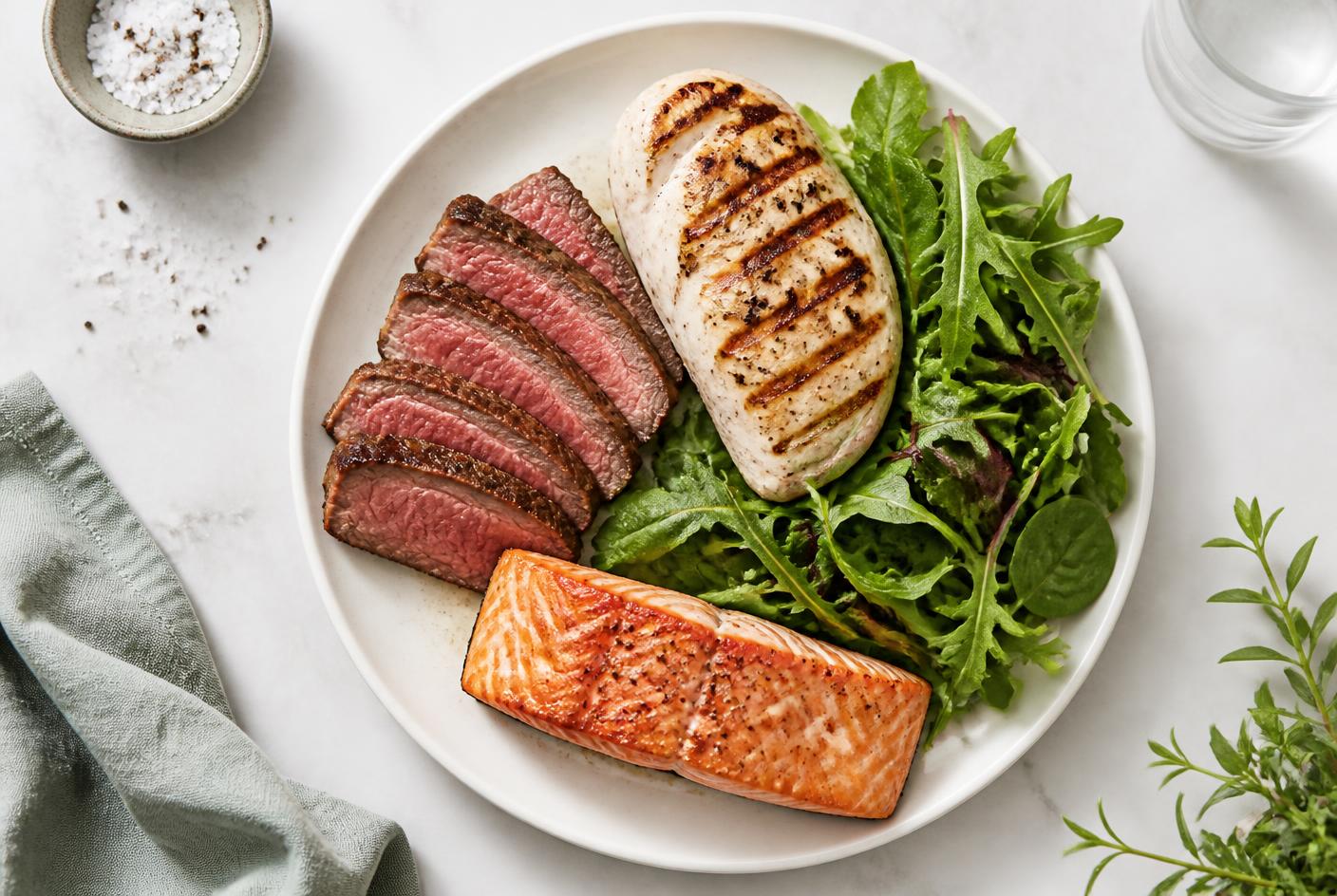
Dietary carnosine comes almost entirely from animal muscle — beef, chicken, pork, fish. Plant foods contain essentially none. If you eat little or no meat, that is worth knowing, though it is not on its own a reason to buy anything.
Much of the carnosine taken by mouth is broken down by an enzyme called carnosinase, which is one reason beta-alanine became the standard research tool for raising muscle levels. Beta-alanine studies typically run for weeks, and a tingling sensation is a commonly reported side effect at higher single doses.
Where topical application fits
Topical delivery is a different proposition again. It is best understood as putting a formula on a specific area — the quads after a long ride, the shoulders after pressing — rather than as a proven way to change muscle chemistry. Topical carnosine has been studied in other tissues, such as skin samples in the lab and the eye, where a modified form (N-acetylcarnosine) has been tested as eye drops by the company that developed them (Babizhayev, 2009). That research is about skin and eyes, not muscle, so it isn't evidence for what a gel does in a hamstring.
What the topical research shows so far is limited. A small 2025 study in seven elite rugby sevens players reported higher peak power in some sprints after a topical carnosine gel compared with a placebo gel. What it did not measure is whether carnosine reached the muscle, and the authors called for that research. One small study is a starting point, not a conclusion — it doesn't show that a topical product raises muscle carnosine, treats injury or changes how you age. What you can rely on is the routine: the consistent warm-up, the short cooldown, the habit that survives a busy week.
Practical considerations for staying active over time
If the buffering story interests you, the useful takeaway is not a purchase. It is that the capacity in question responds to training. Short, hard, repeatable efforts are the stimulus that loads the system, and they are also the thing most people quietly drop from their week somewhere in their forties.
Keep one weekly session with efforts in the thirty-second to five-minute range — hill repeats, bike intervals, a rowing ladder. Quality over volume.
Protect strength work. Keeping muscle matters for everyday function as you age.
Eat enough protein, from sources you will actually repeat. If you eat no meat, be more deliberate about overall protein and consider discussing supplementation with a practitioner.
Treat recovery as scheduled, not optional. A short, fixed cooldown you finish beats a long one you skip.
Change one variable at a time so you can tell what helped.
For anyone working with clients rather than themselves, we keep a separate page on how the gel is used in practice settings, including with NDIS participants and clinic clients: see information for practitioners.
Common questions
What is carnosine?
Carnosine is a dipeptide made of beta-alanine and histidine that the body produces and stores mainly in skeletal muscle. It helps buffer acidity inside muscle and has shown antioxidant and anti-glycation activity in laboratory research.
Does muscle carnosine decline with age?
Some studies report lower muscle carnosine in older or middle-aged adults than in young adults; one larger study found most of the drop happened between young adulthood and middle age. These are associations; they do not show that the decline causes age-related loss of performance.
Can you increase muscle carnosine?
In research, taking beta-alanine by mouth for several weeks raises muscle carnosine. Dietary carnosine comes from meat and fish. Much oral carnosine is broken down by the enzyme carnosinase.
Does topical carnosine raise muscle carnosine levels?
Current evidence does not establish that topical carnosine raises muscle carnosine. The one small human gel study we know of measured sprint power, not muscle carnosine levels.
Is carnosine only relevant for athletes?
Carnosine is not only of interest to athletes. Muscle buffering plays a part in any short, hard effort, and researchers also study carnosine in ageing, brain and metabolic health, mostly in laboratory, animal or small human studies.
Who should be cautious?
Anyone pregnant or breastfeeding, taking prescription medication, or managing a health condition should speak with their doctor before starting a supplement or a new topical product. For topical gels, avoid broken skin, patch test first, and stop use if irritation occurs.
References
Sources & further reading
- 1β-alanine supplementation to improve exercise capacity and performance: a systematic review and meta-analysis (opens in a new tab)
Saunders B, et al. British Journal of Sports Medicine, 2017. PMID 27797728
- 2Carnosine, taurine and enzyme activities of human skeletal muscle fibres from elderly subjects with osteoarthritis and young moderately active subjects (opens in a new tab)
Tallon MJ, et al. Biogerontology, 2007. PMID 16967207
- 3The influence of sex, age and heritability on human skeletal muscle carnosine content (opens in a new tab)
Baguet A, et al. Amino Acids, 2012. PMID 22170500
- 4State of the art clinical efficacy and safety evaluation of N-acetylcarnosine dipeptide ophthalmic prodrug (opens in a new tab)
Babizhayev MA, et al. Current Clinical Pharmacology, 2009. PMID 19149498
- 5Carnosine, the anti-ageing, anti-oxidant dipeptide, may react with protein carbonyl groups (opens in a new tab)
Hipkiss AR, et al. Mechanisms of Ageing and Development, 2001. PMID 11470131
- 6Effects of carnosine and histidine-containing dipeptides on biomarkers of inflammation and oxidative stress: a systematic review and meta-analysis (opens in a new tab)
Saadati S, et al. Nutrition Reviews, 2024. PMID 38086332
- 7Anserine and carnosine supplementation in the elderly: Effects on cognitive functioning and physical capacity (opens in a new tab)
Szcześniak D, et al. Archives of Gerontology and Geriatrics, 2014. PMID 24880197
- 8Topical carnosine gel improves intermittent high-intensity exercise performance in world-class rugby sevens players (opens in a new tab)
Beaven, et al. Journal of the International Society of Sports Nutrition, 2025. PMID 40859880
Carnosine Active provides educational information about published research and does not provide medical advice. Nothing here is intended to diagnose, treat, cure or prevent any disease. Speak with your doctor or a qualified practitioner about your own circumstances.
Keep exploring
Where to go next.
Research
The studies, summarised
What each study tested, found and doesn't tell us.
Explore the research
Performance & exercise
Lactic acid: what actually happens when you push hard
Read article
Recovery & training